The milestones are coming fast and furious. Today I hooked up power to the house, and nothing blew up, no breakers tripped and the lights in the basement came on.
I already had electricity to the little shed I built to house the solar equipment, and I had burried the 3" conduit the 100+ feet to the house. All I really needed was the wire to connect it. 200 amp service wire is big. Wire sizes get bigger the smaller the number. But once the wire got to zero instead of going negative, they just add zeros. Thus 0, 00, 000, 0000 abbreviated 1/0 2/0, 3/0, 4/0 and pronounced one-ought, two-ought, three-ought, four-ought. I needed a 3-wire set of either 2/0-2/0-1/0 copper ($450) or 4/0-4/0-2/0 aluminum ($150).
I hadn't decided whether to splurge for the copper and I was talking it over with Jordan last week when my neighbor Steve showed up. By his own admission he knows nothing about electrical wiring, but he heard us talking about it and mentioned that there was a coil of "really big wire" laying in the yard. I said it had to be really big, and he said it was, so I followed him over to take a look. Under a piece of plywood sitting in the grass was indeed a large coil of wire. I looked over the casing. 4/0-4./0-2/0 aluminum. It was the right stuff, but was it long enough. We uncoiled it in the driveway. I needed 128 feet. I paced it off. 120 feet. So close. I knew my calculation was generous as I had left an ample amount so as not to come up short.
I told Steve that it was so close the only way to find out if it was going to work was to try it. He agreed to help and we coiled up the monster and tossed it in the back of my truck. I had already pulled the leader rope through the conduit. We taped and tied the rope to one end. Steve went down the hill to pull. I stood at the top and pushed the cable in sections, pausing to apply a generous quantity of special wire lube. Steve didn't have to pull much as the cable slid down easily and once some weight was in the conduit, gravity assisted.
About half way down the cable became hopelessly jammed on something and we had to pull the whole thing up. This took both of us as the now slick wire was difficult to grasp. LIke pulling a 50 foot eel out of a hole. We guessed the problem was that one of the three ends stuck out a bit. We cut it off with a hacksaw (this wire is about 1/2" thick. Too thick for normal wire cutters). We also taped half a plastic soda bottle over the top to make it run smoothely. Back in it went.
This time we had no problems and within a few minutes the other end popped out at the bottom of the hill. It still seemed close. After feeding it through the wall at both ends it was clear it was long enough with only perhaps 3 feet to spare. "Sold" I told Steve.
Today the lights came on. Sadly the roof still leaks. The saga continues.
Saturday, March 26, 2005


Thursday, March 17, 2005
Roof Chimes Not Leaks
We tried another strategy for the leaky, high-tech vent and chimney seals. We surmised that water must be backing up under the standing seam of the adjacent panel and so caulked the entire seam up to the ridge. This was done several weaks ago, but with no significant rain in months, there has been no real-world testing.
But on the 16th and 17th we had a small amount of rain. Truth to tell I was affraid to look, but lo and behold, not a drop. It will take passing through a major storm till I'm really confident, but we seem to have licked this one.
Meanwhile I was able to create a makeshift hook-up my 300 gallon holding tank to the gutter. In the little bit of rain collected a week ago, the roof yielded 275 gallons. In the rain we had over the two days this week 200 gallons was collected, even though the downspout detached one of those days. The collected water has been used to test the DWV and mix the concrete for the porch footings.
An unexpected benefit of the roof design is that when it rains the gutter acts as a water chime.
But on the 16th and 17th we had a small amount of rain. Truth to tell I was affraid to look, but lo and behold, not a drop. It will take passing through a major storm till I'm really confident, but we seem to have licked this one.
Meanwhile I was able to create a makeshift hook-up my 300 gallon holding tank to the gutter. In the little bit of rain collected a week ago, the roof yielded 275 gallons. In the rain we had over the two days this week 200 gallons was collected, even though the downspout detached one of those days. The collected water has been used to test the DWV and mix the concrete for the porch footings.
An unexpected benefit of the roof design is that when it rains the gutter acts as a water chime.
Monday, March 07, 2005
Passing Muster
Today was inspection day, and I passed with flying colors. Because it is such a long trek to get to my house from Astoria, the county seat, I try to group the inspections together. On the list today were: drain-waste-vent (DWV) final, plumbing and electrical rough-in, and the footings for the porch posts prior to pouring concrete. In essence I was asking to be able to cover up the interior walls and proceed to finishing. In fact, I had already covered half of all the interior walls (the backs were visible) and, of course, because of the construction, the exterior walls arrive from the factory already sealed.
DWV
Code requires that there be the equivalent of a 4" vent pipe of venting total for the house. In most houses with two or three bathrooms, and perhaps other venting needs, this is accomplished by a collection of vents. But in my house, with only one bath and everything deliberately grouped close together, as in homes of yore, I have a full 4" stack running out of the house. The options for testing its soundness is to pressurize it with air or to simply fill it full of water. To keep the water from running out into the septic tank there is an inflatable plug that can be inserted into the system (not unlike balloon angioplasty) and expanded with air to hold back the water.
I bought one of these and stuffed it into the cleanout in the basement, pushing it up the pipe and inflating it with a bicycle pump. We filled the stack, about 20 feet high, and all the branch arms with water. As the water came gurgling in the pressure built on the fittings. As it filled to the level of the cleanouts, a few drips from the threaded fittings began to drip. Not crucial, but I decided that they should be refitted with some plumber's goo to ensure there were no issues. This meant draining the system. I took the bladder inflation tube and pressed the little pin of the schrader valve (like on a bicycle tire) and let the air escape. Pssssst WHOOOSH, water burst out of the opening in fire hydrant volumes, jetting up to the ceiling and soaking everything in its path. Jordan, acting swiftly, placed his two hands over the outlet only to direct the flow down onto his pants and boots. In a flash the whole episode was over and we laughed as water dripped down into the pool on the floor, making the dark, back half of the basement even more cave-like. Upon inspection it was clear that the plug had been driven down into the lower pipe, past the cleanout and thus effectively blocked the flowing water and directing it all into the pipe.
The Color of Electricity
There are two bundles of 11 wires each (5 pairs and 1 ground) that run in conduit up from the basement to the attic space. There the emerge from a junction box as Romex and spill down into the walls from above. I used up a full 500 foot roll of white (neutral) and black (hot) wiring just doing the basement, but when I went to Home Depot to buy more they were out of white. Instead I bought a very pale yellow wire. So pale in fact that it could be mistaken for old white wire. In anycase, I was sure that it could be "recolored" by applying a piece of white tape at each end.
Matt, my inspector, took one look at them and declared them "conductor non grata." It seems that only huge wire, larger than number 6, can be relabled. For size six and smaller the neutral must be white. What's really odd is that the off-white, pale yellow wire, which I think could easily be mistaken for neutral can be used for hot! The mysteries of the building code.
Plumbing
I've been living out of 5-gallon water containers again. The pump I had been using at the trailer to give me running water at the kitchen sink was called into service to pressurize the new house for testing. I simply put one end of the pump into a bucket of water and the other temporarily connected to the PEX lines. I had one leak and one hot-cold mixup, but otherwise everything worked splendidly. It was great to see water running into the tub. Ah, I can almost feel the warm water of a future bath.
Matt quickly approved the footings, which are built more like those needed for a highway overpass, and was about to leave when I offered him the spectacle of draining the DWV. He had remarked at the weight that my oversized lines were carrying, and wasn't going to miss this. This time I had drilled holes in a 4" cleanout plug to minimize any backwash. Again, and for the last time, I grabbed the pressure hose. This time i was determined to let only the tiniest puffs of air out until water could only seep around the side, and so let it gently drip out over time. Psst. Nothing. Psst. Nothing. Psst. Nothing. Psst - WHOOOSH. The cap didn't block the outflow of water, but instead concentrated it into a energetic jet of water that streamed out through the center opening. Everthing was soaking again, but at least for the last time. And more importantly I had a good laugh with Matt. And in the end humoring one's inspector is more valuable than a wet basement floor.
DWV
Code requires that there be the equivalent of a 4" vent pipe of venting total for the house. In most houses with two or three bathrooms, and perhaps other venting needs, this is accomplished by a collection of vents. But in my house, with only one bath and everything deliberately grouped close together, as in homes of yore, I have a full 4" stack running out of the house. The options for testing its soundness is to pressurize it with air or to simply fill it full of water. To keep the water from running out into the septic tank there is an inflatable plug that can be inserted into the system (not unlike balloon angioplasty) and expanded with air to hold back the water.
I bought one of these and stuffed it into the cleanout in the basement, pushing it up the pipe and inflating it with a bicycle pump. We filled the stack, about 20 feet high, and all the branch arms with water. As the water came gurgling in the pressure built on the fittings. As it filled to the level of the cleanouts, a few drips from the threaded fittings began to drip. Not crucial, but I decided that they should be refitted with some plumber's goo to ensure there were no issues. This meant draining the system. I took the bladder inflation tube and pressed the little pin of the schrader valve (like on a bicycle tire) and let the air escape. Pssssst WHOOOSH, water burst out of the opening in fire hydrant volumes, jetting up to the ceiling and soaking everything in its path. Jordan, acting swiftly, placed his two hands over the outlet only to direct the flow down onto his pants and boots. In a flash the whole episode was over and we laughed as water dripped down into the pool on the floor, making the dark, back half of the basement even more cave-like. Upon inspection it was clear that the plug had been driven down into the lower pipe, past the cleanout and thus effectively blocked the flowing water and directing it all into the pipe.
The Color of Electricity
There are two bundles of 11 wires each (5 pairs and 1 ground) that run in conduit up from the basement to the attic space. There the emerge from a junction box as Romex and spill down into the walls from above. I used up a full 500 foot roll of white (neutral) and black (hot) wiring just doing the basement, but when I went to Home Depot to buy more they were out of white. Instead I bought a very pale yellow wire. So pale in fact that it could be mistaken for old white wire. In anycase, I was sure that it could be "recolored" by applying a piece of white tape at each end.
Matt, my inspector, took one look at them and declared them "conductor non grata." It seems that only huge wire, larger than number 6, can be relabled. For size six and smaller the neutral must be white. What's really odd is that the off-white, pale yellow wire, which I think could easily be mistaken for neutral can be used for hot! The mysteries of the building code.
Plumbing
I've been living out of 5-gallon water containers again. The pump I had been using at the trailer to give me running water at the kitchen sink was called into service to pressurize the new house for testing. I simply put one end of the pump into a bucket of water and the other temporarily connected to the PEX lines. I had one leak and one hot-cold mixup, but otherwise everything worked splendidly. It was great to see water running into the tub. Ah, I can almost feel the warm water of a future bath.
Matt quickly approved the footings, which are built more like those needed for a highway overpass, and was about to leave when I offered him the spectacle of draining the DWV. He had remarked at the weight that my oversized lines were carrying, and wasn't going to miss this. This time I had drilled holes in a 4" cleanout plug to minimize any backwash. Again, and for the last time, I grabbed the pressure hose. This time i was determined to let only the tiniest puffs of air out until water could only seep around the side, and so let it gently drip out over time. Psst. Nothing. Psst. Nothing. Psst. Nothing. Psst - WHOOOSH. The cap didn't block the outflow of water, but instead concentrated it into a energetic jet of water that streamed out through the center opening. Everthing was soaking again, but at least for the last time. And more importantly I had a good laugh with Matt. And in the end humoring one's inspector is more valuable than a wet basement floor.
Sunday, February 20, 2005
Gutters (photos)
The first section of gutter is up. Like the roof it is stainless steel. I first saw this half-round design with cast clips on youth hostel in California. I've wanted to use it ever since.

The half clips blend well and maintain the clean lines of the rest of the sturcture.

The half-round shape means plenty of fluid capicity with no place for debris to accumulate.
The clips are aluminum and are riveted in place.
The half clips blend well and maintain the clean lines of the rest of the sturcture.
The half-round shape means plenty of fluid capicity with no place for debris to accumulate.
The clips are aluminum and are riveted in place.
Hosed (photo)
The pumps and filters are all installed. This photo doesn't quite capture how spiffy the whole thing looks.

From right to left:
1. Water comes in from a 300 gallon holding tank that catches water off the roof. It is filtered by a 5 micron filter.
2. The water is then pumped back out and uphill to 3000 gallons of storage by a special, low-power Dankoff Slow Pump.
3. Water returns from the tanks and goes through a 1 micron filter.
4. The water is pressurized for household use (ah, I can almost feel the rush of a real shower again), by a very cool Grundfos integrated pump and pressure tank.
5. Finally, the passes through the Trojan UV light to kill anything left in the water. The blue box is the controller for the UV light.
Tuesday, February 15, 2005
Liberation (photo)
I am not a mouse.
Before dawn, before the birds' song, before my first cup of coffee, I arose, donned my long underwear, thermal socks, and cashmere hat and exited my icy shack. Frost covered the windows, and the ground yielded underfoot like chilled cookie dough. As I traversed the 200-yard walk down to my bogged-down tractor, I noted with satisfaction that the standing water had formed into tiny, frozen ponds.
The weather man had been right for a change. Cold and clear. The mercury substitute standing at just above the 20-degree mark. Everything had a light coating of frost; preparing to shimmer the moment the sun crested the low eastern hills.

I climbed aboard and turned the key to the first position. The orange glow plug light came on and I paused for it to extinguish, indicating the machine, Tommy Mow, was ready to start. All was still. A commercial jet, chased by its contrail, made its silent, lumbering way across the sky. I turned the key full to the right and the engine cranked and caught immediately. Like an aging smoker Tommy expelled a few belches of black gunk and then ran smoothly. This time I checked carefully that everything was fully retracted. I grabbed for the seatbelt, but it was frozen to the chassis.
I revved him up to 2500 rpm, and put my foot on the accelerater. Confident, sure-footed and purposeful, Tommy rose up out of his lumber reinforced mud hole, moved forward to a small patch of high ground, obidiently turned to the right, crossed a narrow rivulet and was free. Like a returning comet we swung around the burn pile at the bottom of the garden, and headed home.
The sun rose, the birds sang our praises and everything shimmered.
Before dawn, before the birds' song, before my first cup of coffee, I arose, donned my long underwear, thermal socks, and cashmere hat and exited my icy shack. Frost covered the windows, and the ground yielded underfoot like chilled cookie dough. As I traversed the 200-yard walk down to my bogged-down tractor, I noted with satisfaction that the standing water had formed into tiny, frozen ponds.
The weather man had been right for a change. Cold and clear. The mercury substitute standing at just above the 20-degree mark. Everything had a light coating of frost; preparing to shimmer the moment the sun crested the low eastern hills.
I climbed aboard and turned the key to the first position. The orange glow plug light came on and I paused for it to extinguish, indicating the machine, Tommy Mow, was ready to start. All was still. A commercial jet, chased by its contrail, made its silent, lumbering way across the sky. I turned the key full to the right and the engine cranked and caught immediately. Like an aging smoker Tommy expelled a few belches of black gunk and then ran smoothly. This time I checked carefully that everything was fully retracted. I grabbed for the seatbelt, but it was frozen to the chassis.
I revved him up to 2500 rpm, and put my foot on the accelerater. Confident, sure-footed and purposeful, Tommy rose up out of his lumber reinforced mud hole, moved forward to a small patch of high ground, obidiently turned to the right, crossed a narrow rivulet and was free. Like a returning comet we swung around the burn pile at the bottom of the garden, and headed home.
The sun rose, the birds sang our praises and everything shimmered.
Sunday, February 13, 2005
Mud Wrestling (photos)
It has been an abnormally dry year. While California and British Columbia got soaked, Oregon remained sunny and warm. But on the east side of my new house a river runs through it.
On Friday afternoon, after the work crew had finished prep work on the porch footings, I decided I needed to really get after digging the new footing drain. Now that the porch footings were located I could see exactly where the new drain line needed to go to avoid them.
I wheeled the tractor into place and started digging with the backhoe. It was mucky, but I was pointed downhill and I figured I could my escape just by coasting down to the bottom of the yard, making a right at the burn pile and I then would be on relatively dry ground again.
After repositioning the tractor several times to dig the 30 foot long trench, I was done. I mounted the drivers seat, reached back to pull on the two levers that retract the hydraulic, stabilizing outrigger arms, turned my head south and started to exit the bog. After 10 feet I came to a stop and began to sink. I looked back, and the outrigger, on the opposite side that I had leaned to, had failed to retract. It had been stuck by the suction power of the clay, and dragged through the mud like an anchor. Whether or not this was the actual cause of my getting stuck, I will never know.


Making my own stream

On Friday afternoon, after the work crew had finished prep work on the porch footings, I decided I needed to really get after digging the new footing drain. Now that the porch footings were located I could see exactly where the new drain line needed to go to avoid them.
I wheeled the tractor into place and started digging with the backhoe. It was mucky, but I was pointed downhill and I figured I could my escape just by coasting down to the bottom of the yard, making a right at the burn pile and I then would be on relatively dry ground again.
After repositioning the tractor several times to dig the 30 foot long trench, I was done. I mounted the drivers seat, reached back to pull on the two levers that retract the hydraulic, stabilizing outrigger arms, turned my head south and started to exit the bog. After 10 feet I came to a stop and began to sink. I looked back, and the outrigger, on the opposite side that I had leaned to, had failed to retract. It had been stuck by the suction power of the clay, and dragged through the mud like an anchor. Whether or not this was the actual cause of my getting stuck, I will never know.
I tried using the bucket to raise the front wheels, I rocked it back and forth, I checked that I was in four-wheel drive. But the tractor just kept sinking, eventually settling at the axles.
Making my own stream
Where my tracks had been, water now flowed freely down and pooled under the tractor. It was getting dark. I decided to abandon the effort that evening. I was gone the next day, but swung into the driveway in the early evening upon my return just to make sure it hadn't sunk any farther. It had not.
Animation: Raising the Deere
Today, I went out to raise the Deere. Using the hydraulic outriggers, the bucket and lots of large lumber I was able to raise it up. My plan now is to wait till Tuesday morning when it is supposed to be below freezing overnight and hope that hardens the ground a little. I have also dug a channel in the mud above the backhoe that is diverting the water around the tractor. I could have a neighbor pull me out with his own tractor, but where's the challenge in that? Plus, instead of the ignomy of getting my tractor stuck in the mud and having to be towed, I will be the guy who managed to get a tractor stuck in the mud up to the driver's seat (all tall tales grow taller) using nothing more than his wits and his Leatherman. Am a man or am I a mouse? We will find out in short order.
Monday, February 07, 2005
Let There Be Light (Photos)
I arrived back home from a trip to town just after noon to find the first, upper story, tall window had been installed. I didn't really want to inquire how. The windows are 3 feet x 6 feet, hefty and delicate. Nonetheless there they were. The first one was in and the opening for the second one, shrouded since September, was uncovered. The interior space came to life with the kind of light and joy that only the sun and the sky can achieve. The rays of the sun sped past the openings and drenched the upper back wall exactly as planned. These valuable photons will be collected during fall, spring and winter by cementitious panels that are designed to radiate the energy back at night and otherwise moderate the temperature fluctuations in the house.
As I stood outside looking up at the windows a bald eagle flew from left to right across the roof. A sign of good fortune.

As I stood outside looking up at the windows a bald eagle flew from left to right across the roof. A sign of good fortune.
Front Door.

Front Door.
Ladies and Gentlemen, The Doors! (Photos)
The front and back doors are in. I have a key to the house. Adding some foam around them and sealing the windows make it start to really feel like home.
The doors were made by Mountain View Window and Door of Scappoose, Oregon. I provided the material of 2"-thick, salvaged fir planks from the old shop. The interior doors are also made from salvaged fir, but have panels of solid cedar from the shop exterior. The wood is probably 50-years old. Even so, it's not old-growth. It's simply finished with teak oil.

The doors were made by Mountain View Window and Door of Scappoose, Oregon. I provided the material of 2"-thick, salvaged fir planks from the old shop. The interior doors are also made from salvaged fir, but have panels of solid cedar from the shop exterior. The wood is probably 50-years old. Even so, it's not old-growth. It's simply finished with teak oil.
Front Door.

Back Door
The door hardware is from Emtek and is sandblasted brass. The doors have an easy mass to them. The design is a simple Shaker-inspired pattern of a cross. The doors have numerous pits, bores, channels and from bugs. There are nail holes and the resulting nail stains. There are places that one can see tiny rays of light coming right through the door. They are quite dramatic.
It Leaks, But It's Still Stunning (Photos)
The roof was completed last week under dry weather. Since then Mother Nature has mocked our puny attempts at waterproofing. What is stainless steel and silicone compared to a tortoise shell or the fur of an otter? That's it, a fur roof!


The roof leaks like water torture, in maddening, persistent drips, around the vent and chimney penetrations. The four skylights that were "flashed" the old-fashioned way are gloriously dry, and I expect will be so for a hundred years. The other two holes were flashed using the latest, most modern, installed-from-the-top design. The high-temperature silicone for the chimney is spatula-red (apparently this stuff only comes in one color no matter what the use) and has an astounding temperature range of -100 to +450. The ads say, "... lasts for years but installs in minutes." We have concluded that the old ones have to be removed, which means removing part of the chimney, the roof thuroughly cleaned in that spot and a new, square one (different brand) installed.

Jordan attaches the final piece of ridge cap.
Finished Roof
The roof leaks like water torture, in maddening, persistent drips, around the vent and chimney penetrations. The four skylights that were "flashed" the old-fashioned way are gloriously dry, and I expect will be so for a hundred years. The other two holes were flashed using the latest, most modern, installed-from-the-top design. The high-temperature silicone for the chimney is spatula-red (apparently this stuff only comes in one color no matter what the use) and has an astounding temperature range of -100 to +450. The ads say, "... lasts for years but installs in minutes." We have concluded that the old ones have to be removed, which means removing part of the chimney, the roof thuroughly cleaned in that spot and a new, square one (different brand) installed.
The rather unusual "turnbuckle" detail that will support the gutter.

View from the east.
Wednesday, February 02, 2005
Red Letter Day
I don't have time to write much about it now, nor time to post pictures, but today two great things happened:
- The roof is finally complete.
- The front and back doors are in.
Thursday, January 27, 2005
Human Error
The four water tanks arrived last week, but I had to send 3 of them back. They were 1100 gallons instead of the 1000 gallon tanks I'd ordered. Not a big deal except that the two designs are radically different, the former being short and squat and the latter talll and skinny. The shed I'd built for the tanks accommodates only the taller skinner ones.
Another error, from a different vendor, resulted in several metal fittings ordered galvanized being delivered with out the specified coating. In addition 30 custom brackets were the wrong model completely.
I mention both of these because they were both due to human error on the part of the vendor. Errors that could have been avoided if they would allow ordering through their websites. Or at the very least any error would have been my own. This seems important when in both cases any meager margins for the products were consumed and then some by the errors.
In the case of the tanks, it's a bit more understantable that there is no direct ordering as the logistics of shipping are involved, but in the other case it's harder to understand. The company is Simpson StrongTie and though one has to look up the model and download the custom order form from their website, one is forced to go through a dealer to order them. This seems a complete and unnecessary waste.
On the other hand how far will automation take us? Are these really incompetent humans that can do better or at least not representative of most humans or is some level of incompetence a human trait that we should recognize, and if not celebrate, at least abide? If in order to satisfy my desire to never be inconvenienced in the slightest way the human element must be removed is my being invonvenienced really the most important thing?
Another error, from a different vendor, resulted in several metal fittings ordered galvanized being delivered with out the specified coating. In addition 30 custom brackets were the wrong model completely.
I mention both of these because they were both due to human error on the part of the vendor. Errors that could have been avoided if they would allow ordering through their websites. Or at the very least any error would have been my own. This seems important when in both cases any meager margins for the products were consumed and then some by the errors.
In the case of the tanks, it's a bit more understantable that there is no direct ordering as the logistics of shipping are involved, but in the other case it's harder to understand. The company is Simpson StrongTie and though one has to look up the model and download the custom order form from their website, one is forced to go through a dealer to order them. This seems a complete and unnecessary waste.
On the other hand how far will automation take us? Are these really incompetent humans that can do better or at least not representative of most humans or is some level of incompetence a human trait that we should recognize, and if not celebrate, at least abide? If in order to satisfy my desire to never be inconvenienced in the slightest way the human element must be removed is my being invonvenienced really the most important thing?
The Roof is On
I would say that my mood is bouyant. Good things are happening daily, nay hourly. Most importantly the days are getting longer, warmer, and drier. If one were going to build a house in the winter in coastal Oregon, this was the year to do it. But even so December and January were mentally challenging. But now it's just a delight to go down and work on the house.
The roof is on. Today the last roof panel was finally put into place. There is still the ridge cap to put on (not an easy task) and one that it is hoped will remove the last two drips of rain in the house (around the vent and chimney pipe).
I calculate that on or about February 8th the sun will once again strike the roof. I expect that the effect will be blinding. Pictures soon.
The doors are here. Last week we went and picked up all 6 of them. The two exterior doors are oiled up and ready to be installed. Pictures soon.
I've been working on the electrical system, and making terrific progress. 400 feet of metal conduit had to be run in the basement and that is nearly complete. Soon I will actually hook it up to the panels.
I am targeting April for move-in.
The roof is on. Today the last roof panel was finally put into place. There is still the ridge cap to put on (not an easy task) and one that it is hoped will remove the last two drips of rain in the house (around the vent and chimney pipe).
I calculate that on or about February 8th the sun will once again strike the roof. I expect that the effect will be blinding. Pictures soon.
The doors are here. Last week we went and picked up all 6 of them. The two exterior doors are oiled up and ready to be installed. Pictures soon.
I've been working on the electrical system, and making terrific progress. 400 feet of metal conduit had to be run in the basement and that is nearly complete. Soon I will actually hook it up to the panels.
I am targeting April for move-in.
Friday, January 07, 2005
Still Two Panels Shy of a Roof
Nothing happened on the house between December 20th and today, January 7. It has been dark, wet and near freezing. The house, not being fully enclosed is not the most pleasant place to work. I will confess to some post-holiday reluctance to getting going again. Having spent the holiday in the warm bossom of my parent's home, with lots of hot water, mounds of food, and nothing really to do, I found my return to my dank, fetid, icy hovel of a temporary residence a bit of a shock.
Turning the heat off overnight has meant the house descending to the 45 degree level by morning. I find it is awfully hard to drag my ass out of bed into such a chill.
But today I sucked it up, went out and wired the bathroom. Still, I only worked until 3:30 today when my toes were frozen and my fingertips numb. The forecast is for the cold snap to end after next week. Even so, the entire winter has been relatively dry.
The pumps, water tanks, and filtration equipment have all been ordered from afar and are en route. The doors will be picked up and the exterior ones installed this month. Deck/porch lumber has been ordered and the deck may be truly started this month as well.
I'm still two panels short of a roof. Some say this is also describes me personally. The chimney and vent still leak, but the roofers are convinced that it is water running down from the still open ridge. So the roof will be sealed up in the next week or so, and if it still leaks, then it will have to be reworked in the summer.
The days are getting mercifully longer and in another 45 days we will start seeing signs of spring. I look forward to it more than I do Christmas.
Turning the heat off overnight has meant the house descending to the 45 degree level by morning. I find it is awfully hard to drag my ass out of bed into such a chill.
But today I sucked it up, went out and wired the bathroom. Still, I only worked until 3:30 today when my toes were frozen and my fingertips numb. The forecast is for the cold snap to end after next week. Even so, the entire winter has been relatively dry.
The pumps, water tanks, and filtration equipment have all been ordered from afar and are en route. The doors will be picked up and the exterior ones installed this month. Deck/porch lumber has been ordered and the deck may be truly started this month as well.
I'm still two panels short of a roof. Some say this is also describes me personally. The chimney and vent still leak, but the roofers are convinced that it is water running down from the still open ridge. So the roof will be sealed up in the next week or so, and if it still leaks, then it will have to be reworked in the summer.
The days are getting mercifully longer and in another 45 days we will start seeing signs of spring. I look forward to it more than I do Christmas.
Friday, December 10, 2004
Two Drops Forward, One Drop Back
The roof is more than 3/4 complete, but it leaks in four places. One is the vent flashing. This should be fixed by installing a new one.
The second one is in the skylight that has been flashed, but the roofing above it has not been installed. Thus all the water from 66 square feet of roof runs right under the flashing. Still, it didn’t leak when it had only "paper" flashing. This should be fixed when the additional roof pieces go on.
Third is in the living room above where the aforementioned roofing is to be installed. Should likewise be fixed. Still, it’s incredible that the roof is leaking at all.
Fourth, and the most disturbing one, is in the living room in an already roofed section. This area has never leaked before. The only source for water has to be the very upper edge of the roof that won’t get capped until the whole thing is on. Let’s hope so. I don’t really want to contemplate the alternatives.
The roof is made up of only 8 giant, 10" thick panels. The seams have been glued, and foamed. Then they were foamed again, once in place, and self-adhesive flashing was laid over all the seams (only 4 seams). Atop all this is a 5/8" layer of plywood that is offset to every seam, and is glued and screwed in place. Over all of this is a layer of Tri-Flex 30 roofing "paper". A tough, hurricane rated, polyethyline roofing material. The curbs for the skylights is equally impressivelly flashed. Still...
Never underestimate the persistence of water.
Friday, December 03, 2004
Schedule 40
I loathe days like today. I spent it driving a hundred miles to make 3 stops. Worse than this, I was under a tight deadline to get to my last stop before they closed at 4:30pm. This was necessitated for wont of a vent pipe. The two feet of 4" vent pipe that will stick up above the roof. Often this is left as the 4" of black ABS, painted or covered by some metal roof jack. In my case this was to be, like everything else, stainless steel.
The Zs had volunteered to come up with a piece through their contacts, but suddenly on Wednesday they realized that they were about to cover that area of the roof, and they had no solution. I was in Astoria all day Thursday, and they agreed to solve the problem that day. When I returned home, I swung into the new driveway in the darkness and directed my headlights onto the roof. Little or no progress and no vent tube.
Thus I found myself this morning having to come up with a piece of pipe. Being Friday it was important to get something that day in case our spate of rain-free weather continued. The gods were dangling the good weather in front of us, and we were blowing it. In these past 3 days the roof could have been virtually finished.
I turned to Northwest Metal Products again. They were as responsive as usual, but if we were going to do something with what was on hand, I would have use "schedule 40" stainless steel pipe. I have seen and used the term often, but like so many things in life that we are familiar with, in truth we have no clue what they mean. In this case schedule 40 is the common minimum standard for DWV pipe, for example.
What I had originally wanted was a very thin piece of tubing as a mere cosmetic cover to the pipe or even to couple to the system via what is called a "hubless" coupler. In either case I had in mind something maybe 1/32 of an inch thick. I learned that pipe is really only specified by its outer dimension. I then made the wrongheaded logical jump to conclude in my own mind that surely schedule 40 4" stainless steel pipe would naturally be much thinner than 4" plastic pipe. This notion is further obscured to the novice because schedule 40 pipe is routinely referred to as "thin wall" pipe in the industry even though ABS DWV pipe is 1/8" thick.
In any case, although a c-note to acquire, I ordered it under a bit of duress, and then fled my house to make my own schedule
Boy was I surprised when North West presented me with a nicely polished hunk of tubing weighing in at a good 20 pounds. Remember, it is only 2 feet long. Turns out that schedule 40 is exactly that, a schedule. It's not a formula or a chart, but a schedule where one must look up the material, and nominal diameter and with this determine what schedule pipe to choose to meet one's other requirements. Turns out I really wanted was schedule 10S or even 5S stainless tubing.
One end of my vent pipe is precisely cut at 30 degrees to match the slope of the roof, and northwest had polished it up quite nicely. It is really too beautiful to mount on the roof, and I'm considering keeping it in the living room as a monument to how even the best intentioned modest projects can turn to folly and excess.
The Zs had volunteered to come up with a piece through their contacts, but suddenly on Wednesday they realized that they were about to cover that area of the roof, and they had no solution. I was in Astoria all day Thursday, and they agreed to solve the problem that day. When I returned home, I swung into the new driveway in the darkness and directed my headlights onto the roof. Little or no progress and no vent tube.
Thus I found myself this morning having to come up with a piece of pipe. Being Friday it was important to get something that day in case our spate of rain-free weather continued. The gods were dangling the good weather in front of us, and we were blowing it. In these past 3 days the roof could have been virtually finished.
I turned to Northwest Metal Products again. They were as responsive as usual, but if we were going to do something with what was on hand, I would have use "schedule 40" stainless steel pipe. I have seen and used the term often, but like so many things in life that we are familiar with, in truth we have no clue what they mean. In this case schedule 40 is the common minimum standard for DWV pipe, for example.
What I had originally wanted was a very thin piece of tubing as a mere cosmetic cover to the pipe or even to couple to the system via what is called a "hubless" coupler. In either case I had in mind something maybe 1/32 of an inch thick. I learned that pipe is really only specified by its outer dimension. I then made the wrongheaded logical jump to conclude in my own mind that surely schedule 40 4" stainless steel pipe would naturally be much thinner than 4" plastic pipe. This notion is further obscured to the novice because schedule 40 pipe is routinely referred to as "thin wall" pipe in the industry even though ABS DWV pipe is 1/8" thick.
In any case, although a c-note to acquire, I ordered it under a bit of duress, and then fled my house to make my own schedule
Boy was I surprised when North West presented me with a nicely polished hunk of tubing weighing in at a good 20 pounds. Remember, it is only 2 feet long. Turns out that schedule 40 is exactly that, a schedule. It's not a formula or a chart, but a schedule where one must look up the material, and nominal diameter and with this determine what schedule pipe to choose to meet one's other requirements. Turns out I really wanted was schedule 10S or even 5S stainless tubing.
One end of my vent pipe is precisely cut at 30 degrees to match the slope of the roof, and northwest had polished it up quite nicely. It is really too beautiful to mount on the roof, and I'm considering keeping it in the living room as a monument to how even the best intentioned modest projects can turn to folly and excess.
Wednesday, December 01, 2004
Metallica (Photos)
The stainless steel roof is starting to take shape. Today was the first of a few forecast clear days. The Zs got their first skylight sealed up and it is a thing of beauty. Thanks to the custom made stainless "saddle" I had made and some different side flashing there are up to 4 layers of water proofing with no silicon or caulking of any kind. This is waterproofing the old fashioned way, that is not trying to block water with high-tech sealents, but giving the water an easier path to ground. About 1/3 of the roof is complete, but it was too late to take pictures of it so here are some from earlier in the day. Click on the thumbs for larger images.

Workers in the mist


This doesn't work when it's raining

Doesn't look different from the south

In Oregon you can't have enough roofs

Workers in the mist

Working from the inside out

This doesn't work when it's raining

Doesn't look different from the south
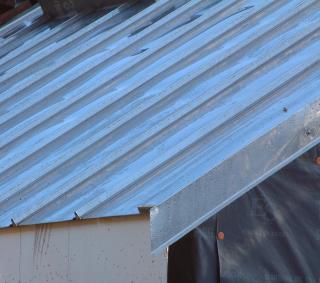
In Oregon you can't have enough roofs
Tuesday, November 23, 2004
Venting (Photo)
There are many things on this house that I'm doing for the first time. One of these is a complete drain-waste-vent (DWV). The drain-waste part isn't that difficult to understand conceptually. After all, as we all know shit flows downhill. But figuring out how to get the vents back to the main stack so that I didn't have to put another hole in the roof was a challenge.
I called for a preliminary inspection before I glued the whole thing together. Matt was nice enough to come out even though it's not routine to inspect unfinished work. He told me my "wet vent" plan wasn't going to fly even though my piping is all well oversized.
It is one of the advantages of a small house. Using the largest possible piping doesn't cost much when the run is only 7'.
I redid the venting, but I didn't like the result after I glued it up. 4" pipe turns out to be tricky because when it is dry-fit it will often not fully seat in the fitting. Even so, it's really hard to take apart. However, once glued, the unset glue acts like a lubricant letting the parts fully engage. Unfortunately this tight fit means that the dimensions shrink. It's easy to lose a half inch or more once the glue goes in. This caused me no end of problems.
Likewise getting all the angles right. It's not so easy in 3D. Understanding that a 45 degree angle pipe needs another 45 degrees to change direction to 90 degrees isn't hard. But what if that 45 degrees is dropping out of the cieling pointing NNE mating to a pipe running east with a 45 degree bend to the south but canted 45 degrees up? The best answer I found is to buy a whole lot of 22, 45, and 90 degree bends and return the ones you don't use.

My first DWV
I called for a preliminary inspection before I glued the whole thing together. Matt was nice enough to come out even though it's not routine to inspect unfinished work. He told me my "wet vent" plan wasn't going to fly even though my piping is all well oversized.
It is one of the advantages of a small house. Using the largest possible piping doesn't cost much when the run is only 7'.
I redid the venting, but I didn't like the result after I glued it up. 4" pipe turns out to be tricky because when it is dry-fit it will often not fully seat in the fitting. Even so, it's really hard to take apart. However, once glued, the unset glue acts like a lubricant letting the parts fully engage. Unfortunately this tight fit means that the dimensions shrink. It's easy to lose a half inch or more once the glue goes in. This caused me no end of problems.
Likewise getting all the angles right. It's not so easy in 3D. Understanding that a 45 degree angle pipe needs another 45 degrees to change direction to 90 degrees isn't hard. But what if that 45 degrees is dropping out of the cieling pointing NNE mating to a pipe running east with a 45 degree bend to the south but canted 45 degrees up? The best answer I found is to buy a whole lot of 22, 45, and 90 degree bends and return the ones you don't use.
My first DWV
The photo shows the completed and entire DWV for the house. The bath was deliberately backed up against the kitchen sink to minimize plumbing and to make the hot water run as short as possible.
I did have to redo the water closet (WC a.k.a. toilet, crapper, shitter, can, head, etc.) and sink portion for the reasons cited above and because I wasn't satisfied that it was an elegant enough solution.
Next hot and cold water.
I did have to redo the water closet (WC a.k.a. toilet, crapper, shitter, can, head, etc.) and sink portion for the reasons cited above and because I wasn't satisfied that it was an elegant enough solution.
Next hot and cold water.
Thursday, November 18, 2004
Solar Story
Part of the plan for the house is a small solar array (1500 W). You might think, as I did, that with the solar industry over 25 years old, that getting the exact product one wants would be easy. It is not. There are few vendors of small systems (sub 2500W) that will sell power back to the utility (grid-tie) and at the same time offer battery backup. I had placed an order for such a product from Xantrex (yet another Canadian company). The grid-tie part was to ship in August, but August brought only an announcement that they had decided not to make the product after all.
This left Outback Power Systems of Washington with the right products. They are a private and relatively new company. There website is horribly out of date, and they seem like the kind of garage company that could fold any minute.
I held off waiting to see if any new products or mergers would be announced. So yesterday I placed the order for an Outback system. I only need the inverter and some mounting equipment. I have had the solar panels for nearly two years now.
This left Outback Power Systems of Washington with the right products. They are a private and relatively new company. There website is horribly out of date, and they seem like the kind of garage company that could fold any minute.
I held off waiting to see if any new products or mergers would be announced. So yesterday I placed the order for an Outback system. I only need the inverter and some mounting equipment. I have had the solar panels for nearly two years now.
Night Shift
By 6pm it is pitch black outside. Clouds or mist routinely obscure the moon. It is dark, cold and quiet in the house. Through the plumbing that I'm working on I can hear the haunting drips in the septic tank. Like listening to the bowels of a cavern from its entrance. I have set a tarp out to collect rainwater and direct it into the empty tank. Even though the tank is concrete I got conflicting reports as to whether or not it would pop up out of the ground: a boat floating in a sea of mud. To be safe I'm directing water into the 1000 gallon tank.
Now that the house is essentially water tight, I thought I would be working late into the night on various aspects of the interior. This as proven not to be the case. By 7 or 8 pm I am done for the night. 500 watts of light (actually a 65W fluourescent) is just not enough to keep me from wanting to hibernate. By contrast, I could stay up to the wee hours working on this computer. When it comes to physical labor, I am definitely diurnal.
Now that the house is essentially water tight, I thought I would be working late into the night on various aspects of the interior. This as proven not to be the case. By 7 or 8 pm I am done for the night. 500 watts of light (actually a 65W fluourescent) is just not enough to keep me from wanting to hibernate. By contrast, I could stay up to the wee hours working on this computer. When it comes to physical labor, I am definitely diurnal.
Subscribe to:
Posts (Atom)

 Posts
Posts

